Pricing
Availability
Usually 1-2 Days (Next working day delivery may be possible) - 1pm cut-off
Shopping Basket
Your shopping basket is currently empty
Quote Request Basket
Your quote request basket is currently empty
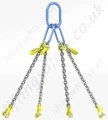
Here we have the Hack8 pre-assembled (and certified) range of grade 8 or, as they are sometimes referred to, grade 80 lifting chain slings, which are available in chain diameters starting from 7mm and incrementally increasing up to the largest size of 32mm.
Alongside the Hack8 line of chain components, there is also the Hack10 range of grade 100 (as with grade 80 being referred to as grade 8, so too you will see grade 10 and grade 100 - these are referring to the one and same, just as with grade 12 and grade 120) chain sling components which primarily have a higher capacity-to-diameter ratio (and so also capacity-to-weight ratio) than the lower grade 80 chain and components.
Though the Hack8 component range is new to the marketplace for 2024, the William Hackett brand is not. For many years, the Hackett brand has been a big name within the industry when it comes to chain, chain slings and chain sling components, so you can rest assured that you are looking at a quality product.
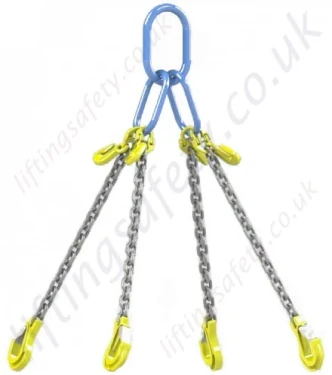
As standard, the slings can be pre-assembled as a 1-leg, 2-leg, 3-leg or 4-leg chain sling, with the increase in legs also increasing the rated capacity (WLL - Working Load Limit) of the assembly, up to three and four-leg chain sling arrangements, where they are both rated the same. The reason for this is that, at any one point, only 3 of the 4 legs will be load-bearing.
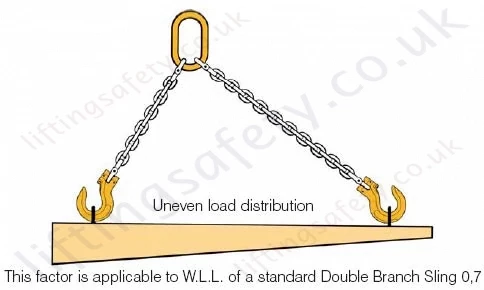
The length of the chain sling (we would refer to this as the EWL, or Effective Working Length, which would be measured from the bearing point of the main ring or master link to the bearing point of the hook) can be supplied as any length that you require (obviously give or take a chain link length), but, a chain sling can also be supplied with temporary shortening grab hooks, which are often very useful for unsymmetrical or uneven loads, or simply an array of different sized objects being lifted.
See the load chart below for more details on WLLs (working load limits) in various configurations.
Uniform Load Method of Rating BS EN 818-4
All general-purpose slings should be rated by the uniform load method as shown in the table below.
| Chain Size | ||||||
| Single Leg Chain Sling | 2 Leg Chain Sling 0°-45° |
2 Leg Chain Sling 45°-60° |
3 and 4 Leg Chain Sling 0°-45 |
3 and 4 Leg Chain Sling 45°-60° |
||
| 7mm | 1.5 tonne | 2.1 tonne | 1.5 tonne | 3.1 tonne | 2.2 tonne | |
| 8mm | 2.0 tonne | 2.8 tonne | 2.0 tonne | 4.2 tonne | 3.0 tonne | |
| 10mm | 3.15 tonne | 4.25 tonne | 3.15 tonne | 6.7 tonne | 4.75 tonne | |
| 13mm | 5.3 tonne | 7.5 tonne | 5.3 tonne | 11.2 tonne | 8.0 tonne | |
| 16mm | 8.0 tonne | 11.2 tonne | 8.0 tonne | 17.0 tonne | 11.8 tonne | |
| 20mm | 12.5 tonne | 17.0 tonne | 12.5 tonne | 26.5 tonne | 19.0 tonne | |
| 22mm | 15.0 tonne | 21.2 tonne | 15.0 tonne | 31.5 tonne | 22.4 tonne | |
| 26mm | 21.2 tonne | 30.0 tonne | 21.2 tonne | 45.0 tonne | 31.5 tonne | |
| 32mm | 31.5 tonne | 45.0 tonne | 31.5 tonne | 67.0 tonne | 47.5 tonne | |
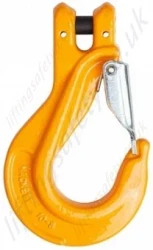
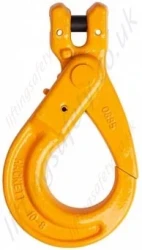
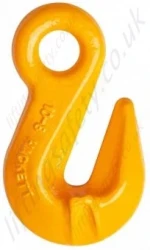
Various fittings for single, two, three, and four-leg chain slings are available, including clevis sling hooks, self-locking hooks, and eye grab hooks, with options for bespoke arrangements.
Take a look at our full range of chain slings to find out more about the options available, including different end fittings, different materials, and higher lifting working load limits.


Note: The chain fittings shown above are the more popular hooks and leg length adjuster types. Chain sling assemblies can be supplied with alternative fittings in Grade 8, Grade 10 or Grade 12 to suit your requirements...
If this is the case, contact us with your requirements (number of legs, capacity, fitting types and length) for a quote.
This information provides detailed WLLs for various chain sizes and configurations, emphasising the importance of selecting the correct chain size and configuration for safe lifting operations. All lifting applications should be assessed by a competent person in order to establish the size and type of sling required.
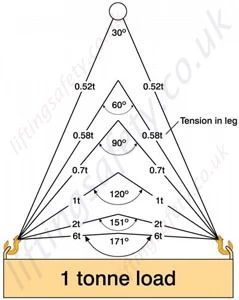
In the case of multi-leg slings, the angle between the legs is critical. The actual tension on each leg increases when the angle between the legs increases, as shown in the diagram opposite. For this reason, all general-purpose chain slings are given a rating based on use at 90º incl. angle. The included angle between the legs should never exceed 120º.
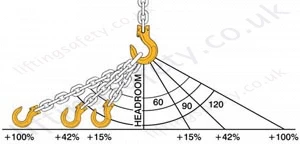
The distance between the crane hook and the load is known as the “Headroom”. If a specific headroom is required, the “Reach” of the chain sling must increase as the angle between the legs increases, as shown opposite.
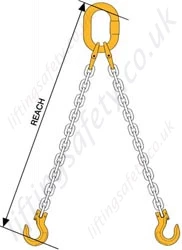
Also known as bearing to bearing (b-b) or chain length.
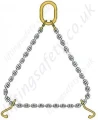
The reach of a chain sling is the distance between the bearing points of the upper and lower terminal fittings. This distance, commonly known as the “Bearing to Bearing”, should be quoted when ordering slings.
Shortening grab hooks may be fitted to a sling, making the reach adjustable, hence increasing the versatility of the sling.
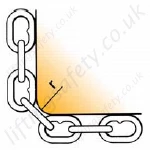
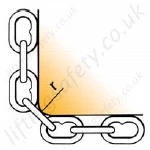
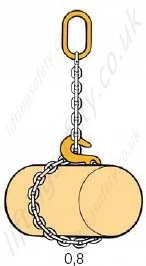
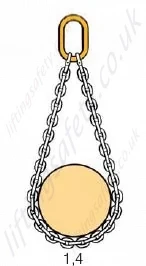
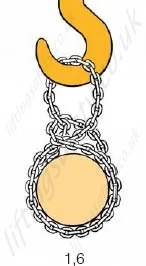
Recommended Load Factors for unusual slinging methods and conditions.
Factor normally applied to W.L.L. of a Single Chain.


r = more than 2 x chain size
1
r = more than chain size
0,7
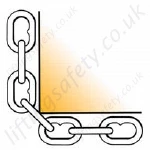
Not recommended without corner protection

Our Grade T(8) Alloy Steel Chain is manufactured specifically for use in chain slings for lifting purposes. The chain is heat treated for tensile strength and resistance to wear whilst also allowing for shock absorption. The chain is easily identifiable with “MA8” embossed at metre intervals.
This document is issued in accordance with the requirements of Section 6 of the Health and Safety at Work etc Act 1974, amended March 1988. It outlines the care and safe use of general purpose CHAIN SLINGS and is based on Section 13 of the LEEA Code of Practice for the Safe Use of Lifting Equipment.* It should be read in conjunction with the requirements for general purpose slinging practice, given overleaf, which form an integral part of these instructions. This information is of a general nature only covering the main points for the safe use of chain slings. It may be necessary to supplement this information for specific applications.
Chain slings are available in a range of material grades, sizes and assemblies. Select the slings to be used and plan the lift taking the following into account:
Never return damaged or contaminated slings to storage. They should be dry, clean and protected from corrosion. Store chain slings on a rack and not lying on the ground. The storage area should be dry, clean and free of any contaminates which may harm the sling. Do not alter, modify or repair a chain sling but refer such matters to a Competent Person. Never galvanise or subject a chain sling to any other plating process without the express approval of the supplier.
Further information is given in: ** HSE Guidance Note PM 39 - Hydrogen Embrittlement of Grade T Chain.* The Code of Practice for the Safe Use of Lifting Equipment, published by: LEEA
The following information is based on Section 1 - Appendix 1.5 of the LEEA Code of Practice for the Safe Use of Lifting Equipment.* It should be read in conjunction with the instructions for the safe use, given overleaf, of which it forms an integral part and with any specific instructions issued by the supplier. This information is of a general nature only covering the main points for the safe use of various types of slings for general lifting purposes.
Slings are available in single, two, three and four leg or endless form. In practice it will be found that chain, wire rope and fibre rope slings are available in any of these configurations but that flat woven webbing is limited to single leg and endless whilst roundslings are only supplied in endless form. The maximum load that a sling may lift in use will be governed by the slinging arrangement (mode of use) and may vary from the marked SWL.** In the case of textile slings the SWL for the various modes of use is usually given on the information label. In other cases it is necessary to multiply the marked SWL by a mode factor.***
The following three simple rules will ensure that the sling is not overloaded. In some cases this will mean that the sling will be under utilised although this is unlikely to hinder the user unduly. Where the maximum utilisation is required reference should be made to a Competent Person who understands the factors involved and who can perform the necessary calculations. (1) For straight lift never exceed the marked SWL and in the case of multi-leg slings the specified angle or range of angles. (2) When using slings in choke hitch multiply the marked SWL by 0.8 to obtain the reduced maximum load the sling may lift ie reduce the safe working load by 20%. (3) With multi-leg slings, when using less than the full number of legs, reduce the maximum load in proportion to the number of legs in use. Simply multiply the marked SWL by the number of legs in use expressed as a fraction of the total thus: one leg of a two leg sling = ½ marked SWL, three legs of a four leg sling = ¾ marked SWL and so on.
Slings should only be used by trained operatives who understand the methods of rating and application of mode factors.**** Safe use of Slings
Further information is given in: *LEEA Code of Practice for the Safe Use of Lifting Equipment. **BS 6166 Part 1 - Lifting Slings, Methods of Rating. *** BS 6166 Part 3 - Selection and Safe Use of Lifting Slings for Multi-purposes. **** HSE Guidance Note GS39 - Training of Crane Drivers and Slingers. Various British Standards covering individual products.
If you wish to receive a quote for this product, please use the Pricing section to the right, this form is for general enquiries regarding this product only.
You can also request a quote through the pricing tab!
You can easily add more than one item to the Quote Request. This is highly recommended as we will be able to suit your needs much more efficiently.
Usually 1-2 Days (Next working day delivery may be possible) - 1pm cut-off
Here we have the Hack8 pre-assembled (and certified) range of grade 8 or, as they are sometimes referred to, grade 80 lifting chain slings, which are available in chain diameters starting from 7mm and incrementally increasing up to the largest size of 32mm.
Alongside the Hack8 line of chain components, there is also the Hack10 range of grade 100 (as with grade 80 being referred to as grade 8, so too you will see grade 10 and grade 100 - these are referring to the one and same, just as with grade 12 and grade 120) chain sling components which primarily have a higher capacity-to-diameter ratio (and so also capacity-to-weight ratio) than the lower grade 80 chain and components.
Though the Hack8 component range is new to the marketplace for 2024, the William Hackett brand is not. For many years, the Hackett brand has been a big name within the industry when it comes to chain, chain slings and chain sling components, so you can rest assured that you are looking at a quality product.
As standard, the slings can be pre-assembled as a 1-leg, 2-leg, 3-leg or 4-leg chain sling, with the increase in legs also increasing the rated capacity (WLL - Working Load Limit) of the assembly, up to three and four-leg chain sling arrangements, where they are both rated the same. The reason for this is that, at any one point, only 3 of the 4 legs will be load-bearing.
The length of the chain sling (we would refer to this as the EWL, or Effective Working Length, which would be measured from the bearing point of the main ring or master link to the bearing point of the hook) can be supplied as any length that you require (obviously give or take a chain link length), but, a chain sling can also be supplied with temporary shortening grab hooks, which are often very useful for unsymmetrical or uneven loads, or simply an array of different sized objects being lifted.
See the load chart below for more details on WLLs (working load limits) in various configurations.
Uniform Load Method of Rating BS EN 818-4
All general-purpose slings should be rated by the uniform load method as shown in the table below.
| Chain Size | ||||||
| Single Leg Chain Sling | 2 Leg Chain Sling 0°-45° |
2 Leg Chain Sling 45°-60° |
3 and 4 Leg Chain Sling 0°-45 |
3 and 4 Leg Chain Sling 45°-60° |
||
| 7mm | 1.5 tonne | 2.1 tonne | 1.5 tonne | 3.1 tonne | 2.2 tonne | |
| 8mm | 2.0 tonne | 2.8 tonne | 2.0 tonne | 4.2 tonne | 3.0 tonne | |
| 10mm | 3.15 tonne | 4.25 tonne | 3.15 tonne | 6.7 tonne | 4.75 tonne | |
| 13mm | 5.3 tonne | 7.5 tonne | 5.3 tonne | 11.2 tonne | 8.0 tonne | |
| 16mm | 8.0 tonne | 11.2 tonne | 8.0 tonne | 17.0 tonne | 11.8 tonne | |
| 20mm | 12.5 tonne | 17.0 tonne | 12.5 tonne | 26.5 tonne | 19.0 tonne | |
| 22mm | 15.0 tonne | 21.2 tonne | 15.0 tonne | 31.5 tonne | 22.4 tonne | |
| 26mm | 21.2 tonne | 30.0 tonne | 21.2 tonne | 45.0 tonne | 31.5 tonne | |
| 32mm | 31.5 tonne | 45.0 tonne | 31.5 tonne | 67.0 tonne | 47.5 tonne | |
Various fittings for single, two, three, and four-leg chain slings are available, including clevis sling hooks, self-locking hooks, and eye grab hooks, with options for bespoke arrangements.
Take a look at our full range of chain slings to find out more about the options available, including different end fittings, different materials, and higher lifting working load limits.


Note: The chain fittings shown above are the more popular hooks and leg length adjuster types. Chain sling assemblies can be supplied with alternative fittings in Grade 8, Grade 10 or Grade 12 to suit your requirements...
If this is the case, contact us with your requirements (number of legs, capacity, fitting types and length) for a quote.
This information provides detailed WLLs for various chain sizes and configurations, emphasising the importance of selecting the correct chain size and configuration for safe lifting operations. All lifting applications should be assessed by a competent person in order to establish the size and type of sling required.
In the case of multi-leg slings, the angle between the legs is critical. The actual tension on each leg increases when the angle between the legs increases, as shown in the diagram opposite. For this reason, all general-purpose chain slings are given a rating based on use at 90º incl. angle. The included angle between the legs should never exceed 120º.
The distance between the crane hook and the load is known as the “Headroom”. If a specific headroom is required, the “Reach” of the chain sling must increase as the angle between the legs increases, as shown opposite.
Also known as bearing to bearing (b-b) or chain length.
The reach of a chain sling is the distance between the bearing points of the upper and lower terminal fittings. This distance, commonly known as the “Bearing to Bearing”, should be quoted when ordering slings.
Shortening grab hooks may be fitted to a sling, making the reach adjustable, hence increasing the versatility of the sling.
Recommended Load Factors for unusual slinging methods and conditions.
Factor normally applied to W.L.L. of a Single Chain.


r = more than 2 x chain size
1
r = more than chain size
0,7
Not recommended without corner protection
Our Grade T(8) Alloy Steel Chain is manufactured specifically for use in chain slings for lifting purposes. The chain is heat treated for tensile strength and resistance to wear whilst also allowing for shock absorption. The chain is easily identifiable with “MA8” embossed at metre intervals.
This document is issued in accordance with the requirements of Section 6 of the Health and Safety at Work etc Act 1974, amended March 1988. It outlines the care and safe use of general purpose CHAIN SLINGS and is based on Section 13 of the LEEA Code of Practice for the Safe Use of Lifting Equipment.* It should be read in conjunction with the requirements for general purpose slinging practice, given overleaf, which form an integral part of these instructions. This information is of a general nature only covering the main points for the safe use of chain slings. It may be necessary to supplement this information for specific applications.
Chain slings are available in a range of material grades, sizes and assemblies. Select the slings to be used and plan the lift taking the following into account:
Never return damaged or contaminated slings to storage. They should be dry, clean and protected from corrosion. Store chain slings on a rack and not lying on the ground. The storage area should be dry, clean and free of any contaminates which may harm the sling. Do not alter, modify or repair a chain sling but refer such matters to a Competent Person. Never galvanise or subject a chain sling to any other plating process without the express approval of the supplier.
Further information is given in: ** HSE Guidance Note PM 39 - Hydrogen Embrittlement of Grade T Chain.* The Code of Practice for the Safe Use of Lifting Equipment, published by: LEEA
The following information is based on Section 1 - Appendix 1.5 of the LEEA Code of Practice for the Safe Use of Lifting Equipment.* It should be read in conjunction with the instructions for the safe use, given overleaf, of which it forms an integral part and with any specific instructions issued by the supplier. This information is of a general nature only covering the main points for the safe use of various types of slings for general lifting purposes.
Slings are available in single, two, three and four leg or endless form. In practice it will be found that chain, wire rope and fibre rope slings are available in any of these configurations but that flat woven webbing is limited to single leg and endless whilst roundslings are only supplied in endless form. The maximum load that a sling may lift in use will be governed by the slinging arrangement (mode of use) and may vary from the marked SWL.** In the case of textile slings the SWL for the various modes of use is usually given on the information label. In other cases it is necessary to multiply the marked SWL by a mode factor.***
The following three simple rules will ensure that the sling is not overloaded. In some cases this will mean that the sling will be under utilised although this is unlikely to hinder the user unduly. Where the maximum utilisation is required reference should be made to a Competent Person who understands the factors involved and who can perform the necessary calculations. (1) For straight lift never exceed the marked SWL and in the case of multi-leg slings the specified angle or range of angles. (2) When using slings in choke hitch multiply the marked SWL by 0.8 to obtain the reduced maximum load the sling may lift ie reduce the safe working load by 20%. (3) With multi-leg slings, when using less than the full number of legs, reduce the maximum load in proportion to the number of legs in use. Simply multiply the marked SWL by the number of legs in use expressed as a fraction of the total thus: one leg of a two leg sling = ½ marked SWL, three legs of a four leg sling = ¾ marked SWL and so on.
Slings should only be used by trained operatives who understand the methods of rating and application of mode factors.**** Safe use of Slings
Further information is given in: *LEEA Code of Practice for the Safe Use of Lifting Equipment. **BS 6166 Part 1 - Lifting Slings, Methods of Rating. *** BS 6166 Part 3 - Selection and Safe Use of Lifting Slings for Multi-purposes. **** HSE Guidance Note GS39 - Training of Crane Drivers and Slingers. Various British Standards covering individual products.
If you wish to receive a quote for this product, please use the tab, this form is for general enquiries regarding this product only.
You can also request a quote through the pricing tab!
You can easily add more than one item to the Quote Request. This is highly recommended as we will be able to suit your needs much more efficiently.
LiftingSafety uses cookies to improve your user experience.
Find out more