How it works
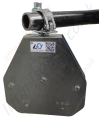
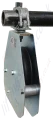
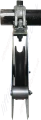
The Poulistop rope blocking system works by a brake which slides along a vertical axis and acts by wedging on the rope against a metal axis. When the slack side of the rope is vertical, it engages the brake, which then exerts an effort of wedging on the rope, which locks in position. So the resisting force of the rope is directly proportional to the load. In order to free the rope the operator has to apply a 15° angle to release the brake.
Additional Information
The effectiveness of blocking is guaranteed by the contact between the rope and the brake. Consequently, these two elements must be the subject of a routine inspection, and be replaced if necessary. In any event, the installation of a new rope must be accompanied by the replacement of the brake.
The blocking of the load enables the operator to stop the movement of rise or descent by ensuring them resumption of the load.
This is only for assisting the operator, it is not allowed to leave the load in suspension without monitoring.
The rope’s blocking must always be engaged before releasing the slack side of the rope: if not, during a operation (voluntary or not), the brake will function (provided that the slack side can be repositioned vertically) but the stopping distance of the load can strongly vary according to the conditions of use, and in addition an accelerated wear of the components of blocking (cam, cord) is to regret.
The POULISTOP 2 brake has to be free from grease and has to rotate freely. This piece has to be cleaned regularly. We advise not to use the POULISTOP 2 at temperatures below zero degrees.
Always ensure that the mechanical resistance of anchorage point of a POULISTOP 2 accept at least 108 kg.
- NEVER USE FOR PERSONNEL LIFTING
- The operator is not authorised to release the rope or leave equipments out of control when a load is hanged up on a pulley.
- Strictly forbidden to either be under or to walk under the load.
- Always use suitable rope (size, length and capacity)
- Always suspend the load on the indicated side (see marking on pulley)
- The pulley should be regularly inspected (priory checking : parts correctly assembled, no excessive movement, no excessive wearing or corrosion, no deformation, free rotating sheave)
- Never use a pulley with a hook as head fitting without ensuring that the safety latch is correctly operated and free from deformation.
- For lifting operations, the user must refer to the safety rules and regulations applicable to this use
- Never install POULISTOP 2 as a return pulley