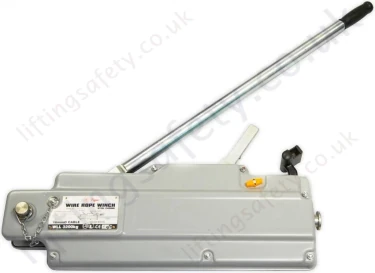
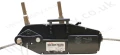
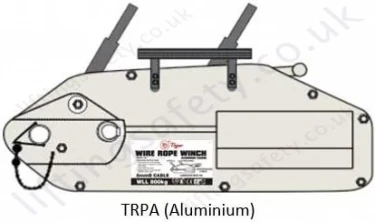
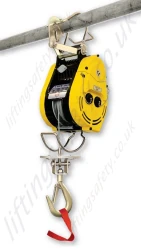
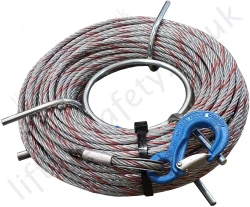
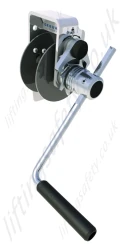
Tiger wire rope pulling machines are suitable for pulling, lifting, tensioning and releasing in any direction.
Available in light and compact aluminium or pressed steel construction for applications where aluminium is not recommended.
These units meet and exceed all the requirements within BS EN 13157:2004+A1:2009.
The manual wire rope puller is a hand operated lifting and pulling device. The puller could also be used for lowering, tensioning and guying which makes it a versatile, portable and multipurpose tool.
The principle function of the wire puller is that the rope passes through mechanical jaws rather than being reeled on a drum of a puller or conventional winch. The tension of the rope is applied by means of two pairs of self-energized jaws which apply a grip onto the wire rope in sections. The effort is transferred to the jaws by two parallel levers, one for forward operation and the other for reverse operation. A telescopic bar, fitted to either the forward or reverse lever, transmits the effort to the jaw mechanism. This parallel clamping system provides an evenly distributed grip at a lower force, resulting in less rope wear. The load is held securely at all times.
Features
- Range from 800kg to 5400kg (Lifting Capacity)
- Corrosion free aluminium alloy casing
- Rope clamp system easily disengaged with a lever allowing smooth installation of wire rope.
- Shear pins can be replaced without removing the load.
- Individually serial numbered for traceability.
- Lightweight manual pulling machines - simple and safe to operate.
- Usable at horizontal, vertical and angled working positions.
- Equipped with an anchor bolt offering numerous connection possibilities.
- Spare shear pins supplied
- Supplied with relevant certification and user instructions.
- Compact high-strength.
- 20m steel wire with eye hook as standard option.
- Overload protection built in, with a shearing pin in the forward lever.
- Parallel clamping system providing evenly distributed grip at a lower force, resulting in less rope wear.
Increase the Pulling and Lifting Capacity:
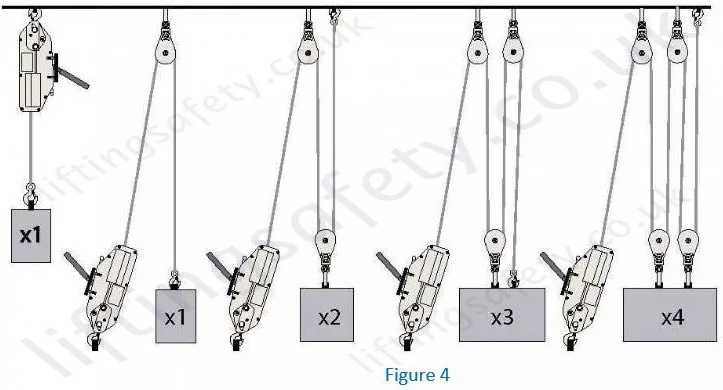
Various methods of rigging are shown. For the correct and incorrect method refer to figures 1 and 2. Other methods of rigging will increase the capacity of the machine – refer to figures 3 and 4.
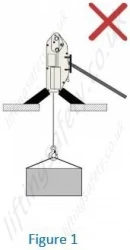
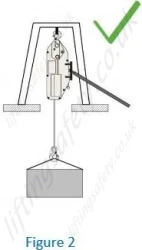
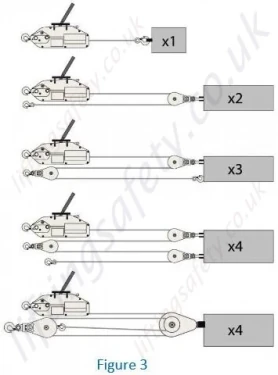
In examples 3 and 4 the maximum working load limit (WLL) of the pulley and anchor point shall be equal to or greater than two times the WLL.
NOTE: When the wire rope puller is anchored directly to a fixed point, ensure that there are no obstructions around the machine which could prevent the wire rope, puller and anchor from operating in a straight line.
It is recommended to use a sling of similar capacity between the anchor point and the unit.
WARNING: Any rigging configuration which requires the calculation of forces applied should be checked by a competent engineer, with special attention to the strength of the fixed point used.
Certification
Each unit comes fully certified with a test certificate or an EC Declaration of Conformity stating compliance with the essential health and safety requirements of the Machinery Directive 2006/42/EC.
Dimensions & Specifications
| Product Code (ALUMINIUM CASING) |
WLL (kg) |
Pulling Capacity (kg) |
Rope Diameter (mm) |
Breaking strain (kN) |
Effort (kg) |
Advance/Pull (mm) |
Net Weight (kg) |
Overall Length (mm) |
Overall Height (mm) |
Overall Width (mm) |
| TRPA-08 |
800 |
1200 |
8.3 |
43 |
35 |
52 |
6 |
426 |
235 |
64 |
| TRPA-16 |
1600 |
2400 |
11 |
120 |
41 |
55 |
11 |
545 |
280 |
97 |
| TRPA-32 |
3200 |
4800 |
16 |
162 |
45 |
28 |
22 |
660 |
325 |
116 |
| TRPA-54 |
5400 |
8000 |
20 |
264 |
76 |
30 |
59 |
930 |
480 |
152 |