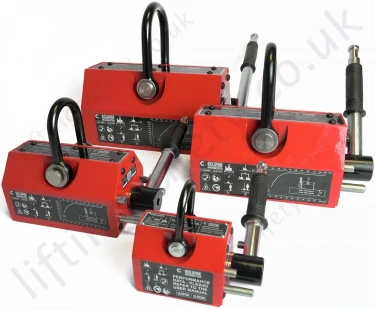
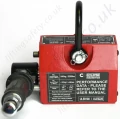
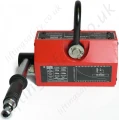
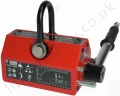
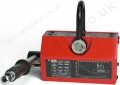
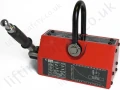
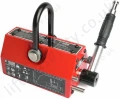
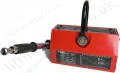
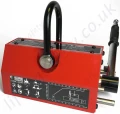
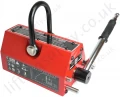
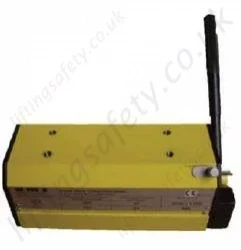
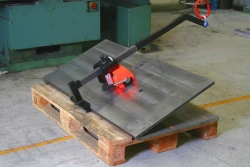
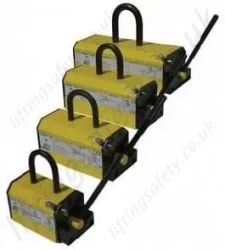
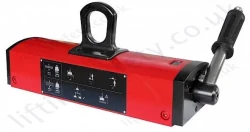
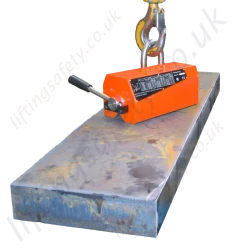
The UltraLift E lifter range is a performance lifter for safely lifting ferrous plate and round bar, with a 3:1 WLL design and a Locking Safety Mechanism for the manual lever to make the lift safer. The performance of these units is always application-specific.
Features
- 3:1 WLL - safely lift ferrous material
- Lifts up to 2000kg Flat Plate*
- Lifts up to 500kg Round Bar*
- A lever to manually switch ‘On’ and ‘Off’
Never exceed the WLL (Working Load Limit) - formerly the SWL (Safe Working Load). The Safety Factor for lifting is 3:1 for this range. Always use LOLER, PUWER, ASME B30.20 and H&S advice.
The UltraLift E range is used to lift ferrous sheets and ferrous round bar. Depending on the version, the UltraLift E can be used on a minimum ferrous plate thickness of 7.5mm (bearing in mind that the thinner the plate, the less the holding force achieved will be). For safely lifting thinner plates and sheets, please use the UltraLift TP range.
Flat Plate
The WLL* varies from up to 100kg for the ULE0100, rising to up to 1000kg (2200lb) for the ULE1000 when used on a ferrous flat plate.
Round Bar
The WLL* varies from up to 50kg for the ULE0100 (80mm maximum diameter), rising to up to 500kg for the ULE1000 (180mm maximum diameter) when used on ferrous round bar (diameter limits apply for each version).
Do not use any lifter if it appears to be damaged. Inspect the lifter at least annually. We can inspect and service/repair our Lifters for you.
Benefits
- No Power Supply required
- 3:1 Safety Factor for lifting
- Lifts Ferrous Plate up to 1000kg*
- Lifts Ferrous Round Bar up to 500kg*
- Locking switch handle safety mechanism
Performance
- Magnetic Performance: Up to 1000kg WLL (value varies with thickness and/or diameter) - see table below
- Magnet Type: Permanent Magnet Lifter
- Temperature Range: -10°C to +40°C (14°F to +104°F)
- Humidity Tolerance: 80%
Materials
- Magnet Material Rare earth neodymium iron boron (NdFeB)
- End plates Aluminium - painted
- Housing Mild steel
- Pole feet Mild steel
Maintenance
- As part of LOLER, PUWER, ASME B30.20 and H&S advice, you need to regularly inspect Lifters to ensure they are not damaged and are suitable for lifting the parts.
- Annual inspection is a minimum requirement
Suitability
- Suitable Products: Ferrous materials (e.g. mild steel)
- Suitable Location Example - factory shopfloor/production line
Conformity
- The Supply of Machinery (Safety) Regulations 2008
- The Electrical Equipment (Safety) Regulations 2016
- The Electromagnetic Compatibility Regulations 2016
- LOLER Regulations 1998
Designated standards: EN ISO 12100:2010, EN 13854:2019, EN 13155:2020
Specifications
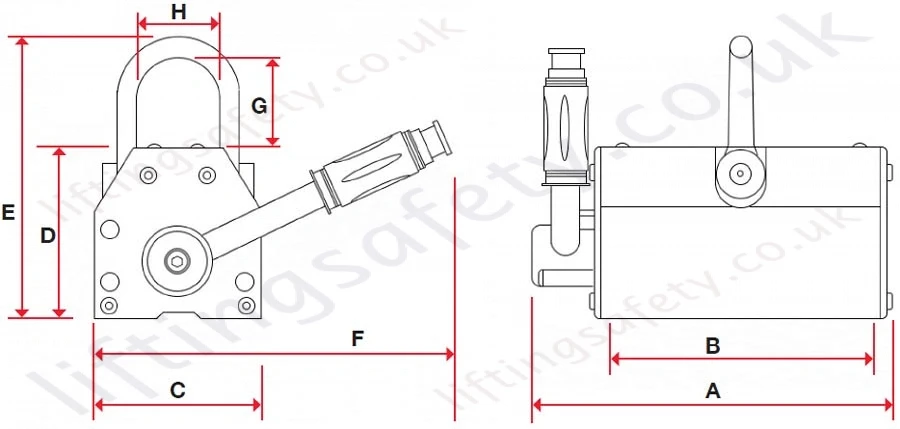
| Part Number |
Dimensions (mm) |
Self-Weight (kg) |
Flat Plate/Section WLL* (kg) |
Flat Plate/Section Minimum Thickness (mm) |
Maximum Material Length (mm) |
Round Bar WLL* (kg) |
Round Bar Maximum Diameter (mm) |
| A |
B |
C |
D |
E |
F |
G |
H |
| ULE0100 |
131 |
88 |
65 |
73 |
124 |
175 |
45 |
32 |
3 |
100 |
15 |
1000 |
50 |
80 |
| ULE0300 |
202 |
157 |
95 |
95 |
169 |
253 |
63 |
46 |
10 |
300 |
20 |
1500 |
150 |
100 |
| ULE0600 |
295 |
240 |
120 |
118 |
220 |
285 |
90 |
61 |
23 |
600 |
30 |
2000 |
300 |
140 |
| ULE1000 |
355 |
300 |
132 |
140 |
269 |
315 |
115 |
73 |
39 |
1000 |
40 |
2500 |
500 |
180 |
| ULE2000 |
442 |
378 |
162 |
170 |
310 |
410 |
120 |
91.5 |
74 |
2000 |
50 |
3000 |
900 |
300 |
*Please note that the Working Load Limit (WLL) is now used instead of the Safe Working Load (SWL). The Lifting force values shown include the 3:1 safety factor and have been based on using thick, high magnetic permeability steel with no air gaps. Air gaps, thinner materials and materials with lower magnetic permeability can all reduce the pull force a lifter can actually achieve. Please note that the achievable pull force is reduced when lifting a thinner mild steel plate. Please note that the diameter of the round bar can affect the amount of lift that can be achieved. You must follow LOLER, PUWER, ASME B30.20 and H&S advice. You should always check for a downrate, factor in any downrate to then perform a safety lift, then perform a full lift only after a successful safety lift.