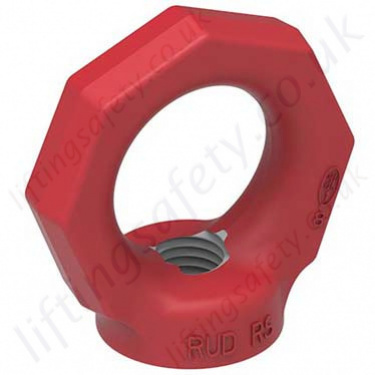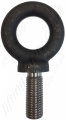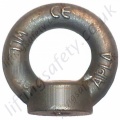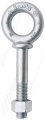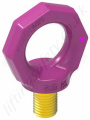
RUD RM Grade 8 Eye nuts (Non Swivel) - Range from 400kg to 32000kg
Model: RUD RM / G8EN-53Grade 8 Eye nuts - RUD RM : M6 - M48.

RUD Lifting / Lashing Eyenut
With the following characteristics, distinctive in comparison to the conventional DIN - eye nuts;
- An octagonal shape symbolising quality class 8
- Colored red, the identification color of quality class 8
- Identification : Clear WLL indication for the most unfavorable load direction F2 (not permissible for DIN 581).
- Forged mateterial 1.6541, high tensile and annealed, 100% electromagnetic crack detected according to EN 1677-1 and with a 4 :1 design factor.
- Loaded in the direction F1, an up to four times higher factor of the value F2 is acceptable. Always make sure that the eye nut is tight before loading.
- Swiveling movements must be avoided during transportation.
Not suitable for swiveling under load.
It does not automatically adjust to the direction of pull hence not permitted in the mining industry.
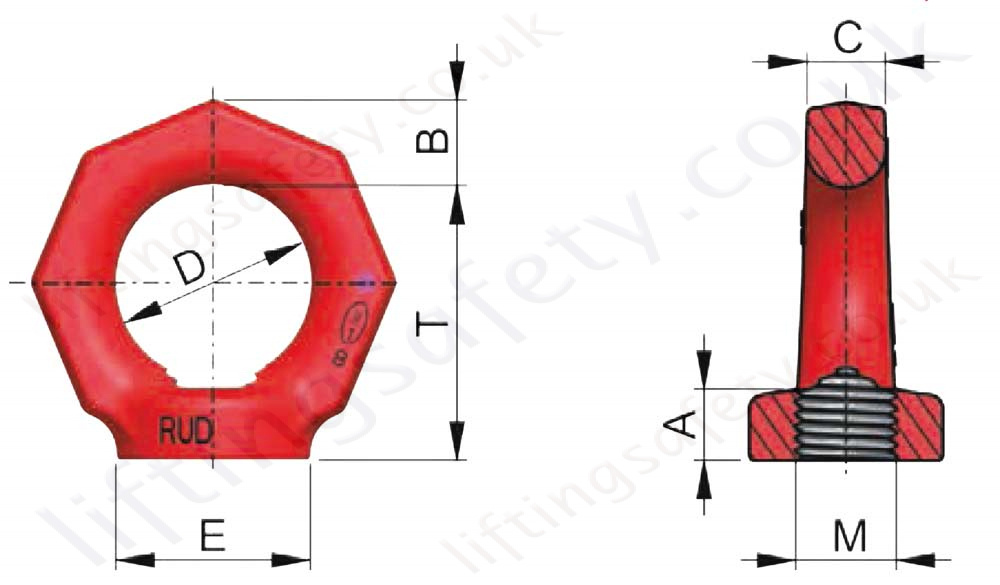
For the RUD RM - eye nuts, the threaded connector component must be of at least quality grade 8.8. Without an additional washer, the seat - engaging surface (E) must evenly and completely lie onto the surface of the work piece.
Impact loaded or when operated in environments with vibrations, unintentional loosening can happen.
Securing possibilities: Use of a liquid thread securing medium eg. Loctite ( follow the manufacturer`s recomendations) or positive bolt securing.
Higher WLL than compared with DIN 582 eye nuts.
Forged, tempered and 100% crack detected. Fool-proof compared with common DIN eye nuts by:
- Shape: Octagonal means quality class 8
- Identification: Distinct indication of WLL for the most unfavourable case (lateral load - not allowed with DIN 582).
- In order to guarantee the WLL, the thread connection must at least consist of quality 8.8.
- Eyenut must be bolted tight during use.
- Avoid twisting movements during transport.
Load Chart
A non-adherence to this advice may result damages of persons and materials!
Table 1
| Method of Lift | ![]() |
![]() |
![]() |
![]() |
![]() |
![]() |
![]() |
![]() |
||
| Number of Legs | 1 | 1 | 2 | 2 | 2 | 2 | 2 | 3 and 4 | 3 and 4 | 3 and 4 |
| Angle of Inclination < ß | 0° | 90° | 0° | 90° | 0-45° | 45-60° | unsymmetrical | 0-45° | 45-60° | unsymmetrical |
| Metric type | RUD Eyenut - WLL in metric tonnes, Bolted | |||||||||
| RM-M6 | 400kg | 100kg | 800kg |
For These kind of lifting purposes we recommend lifting point which can be adjusted to direction of pull. |
||||||
| RM-M8 | 800kg | 200kg | 1.6 t | |||||||
| RM-M10 | 1t | 250kg | 2t | |||||||
| RM-M12 | 1.6t | 400kg | 3.2t | |||||||
| RM-M16 | 3.2t | 800kg | 6.4t | |||||||
| RM-M20 | 6t | 1.5t | 12t | |||||||
| RM-M24 | 8t | 2t | 16t | |||||||
| RM-M30 | 12t | 3t | 24t | |||||||
| RM-M36 | 16t | 4t | 32t | |||||||
| RM-M42 | 24t | 6t | 48t | |||||||
| RM-M48 | 32t | 8t | 64t | |||||||
Thread and Capacity options
Table 2 - Metric Measurements
| Drawing |
Model | Thread | Thread Pitch (mm) | WLL | Weight (kg) | A (mm) | B (mm) | C (mm) | D (mm) | E (mm) | F (mm) | T (mm) | Ref No. |
![]() |
RM-M 6 | ISO Metric | 1 | 100kg | 0.1kg | 12 | 11 | 10 | 25 | 25 | 6 | 34 | 55254 |
| RM-M 8 | ISO Metric | 1.25 | 200kg | 0.1kg | 12 | 11 | 10 | 25 | 25 | 8 | 34 | 55255 | |
| RM-M 10 | ISO Metric | 1.5 | 250kg | 0.1kg | 12 | 11 | 10 | 25 | 25 | 10 | 34 | 55258 | |
| RM-M 12 | ISO Metric | 1.75 | 400kg | 0.2kg | 14 | 13 | 12 | 30 | 30 | 12 | 41 | 55271 | |
| RM-M 14 | ISO Metric | 2 | 750kg | 0.3kg | 16 | 15 | 14 | 35 | 35 | 14 | 48 | 55281 | |
| RM-M 16 | ISO Metric | 2 | 800kg | 0.3kg | 16 | 15 | 14 | 35 | 35 | 16 | 48 | 55460 | |
| RM-M 18 | ISO Metric | 2.5 | 1200kg | 0.4kg | 18 | 17 | 16 | 40 | 40 | 18 | 55 | 55342 | |
| RM-M 20 | ISO Metric | 2.5 | 1500kg | 0.35kg | 18 | 17 | 16 | 40 | 40 | 20 | 55 | 55343 | |
| RM-M 22 | ISO Metric | 2.5 | 1500kg | 0.65kg | 22 | 21 | 20 | 50 | 50 | 22 | 70 | 55387 | |
| RM-M 24 | ISO Metric | 3 | 2000kg | 0.6kg | 22 | 21 | 20 | 50 | 50 | 24 | 70 | 55394 | |
| RM-M 27 | ISO Metric | 3 | 2000kg | 1.4kg | 28 | 26 | 24 | 60 | 60 | 27 | 85 | 55399 | |
| RM-M 30 | ISO Metric | 3.5 | 3000kg | 1.3kg | 28 | 26 | 24 | 60 | 60 | 30 | 85 | 55438 | |
| RM-M 36 | ISO Metric | 4 | 4000kg | 5.5kg | 40 | 43 | 38 | 90 | 100 | 36 | 130 | 53093 | |
| RM-M 42 | ISO Metric | 4.5 | 6000kg | 5.4kg | 40 | 43 | 38 | 90 | 100 | 42 | 130 | 53095 | |
| RM-M 48 | ISO Metric | 5 | 8000kg | 5.3kg | 40 | 43 | 38 | 90 | 100 | 48 | 130 | 53098 | |
| RM- 3/8“-16UNC | Imperial UNC | - | 200kg | 0.1kg | 12 | 11 | 10 | 25 | 25 | 3/8“ | 34 | 7101103 | |
| RM- 1/2“-13UNC | Imperial UNC | - | 350kg | 0.2kg | 14 | 13 | 12 | 30 | 30 | 1/2“ | 41 | 7101104 | |
| RM- 5/8“-11UNC | Imperial UNC | - | 750kg | 0.2kg | 16 | 15 | 14 | 35 | 35 | 5/8“ | 48 | 7101105 | |
| RM- 3/4“-10UNC | Imperial UNC | - | 1200kg | 0.45kg | 18 | 17 | 16 | 40 | 40 | 3/4“ | 55 | 7101106 | |
| RM- 7/8“-9UNC | Imperial UNC | - | 1500kg | 0.7kg | 22 | 21 | 20 | 50 | 50 | 7/8“ | 70 | 7101107 | |
| RM- 1“-8UNC | Imperial UNC | - | 2000kg | 1.5kg | 28 | 26 | 24 | 60 | 60 | 1“ | 85 | 7101108 |
Table 3 - Imperial Measurements
| Drawing |
Model | Thread | WLL (lbs) |
Weight (lbs) |
A (in.) |
B (in.) |
C (in.) |
D (in.) |
E (in.) |
F (in.) |
T (in.) |
Ref No. |
![]() |
RM-M 6 | ISO Metric | 220 | 0,22 | 15/32“ | 7/16“ | 25/64“ | 1“ | 1“ | M6 | 1 11/32“ | 55254 |
| RM-M 8 | ISO Metric | 440 | 0,22 | 15/32“ | 7/16“ | 25/64“ | 1“ | 1“ | M8 | 1 11/32“ | 55255 | |
| RM-M 10 | ISO Metric | 550 | 0,22 | 15/32“ | 7/16“ | 25/64“ | 1“ | 1“ | M10 | 1 11/32“ | 55258 | |
| RM-M 12 | ISO Metric | 880 | 0.44 | 9/16“ | 1/2“ | 15/32“ | 1 3/16“ | 1 3/16“ | M12 | 1 5/8“ | 55271 | |
| RM-M 14 | ISO Metric | 1650 | 0,66 | 5/8“ | 19/32“ | 9/16“ | 1 3/8“ | 1 3/8“ | M14 | 1 7/8“ | 55281 | |
| RM-M 16 | ISO Metric | 1760 | 0,66 | 5/8“ | 19/32“ | 9/16“ | 1 3/8“ | 1 3/8“ | M16 | 1 7/8“ | 55460 | |
| RM-M 18 | ISO Metric | 2640 | 0,88 | 23/32“ | 43/64“ | 5/8“ | 1 9/16“ | 1 9/16“ | M18 | 2 5/32“ | 55342 | |
| RM-M 20 | ISO Metric | 3300 | 0,77 | 23/32“ | 43/64“ | 5/8“ | 1 9/16“ | 1 9/16“ | M20 | 2 5/32“ | 55343 | |
| RM-M 22 | ISO Metric | 3300 | 1,4 | 7/8“ | 13/16“ | 25/32“ | 1 31/32“ | 1 31/32“ | M22 | 2 3/4“ | 55387 | |
| RM-M 24 | ISO Metric | 4400 | 1,35 | 7/8“ | 13/16“ | 25/32“ | 1 31/32“ | 1 31/32“ | M24 | 2 3/4“ | 55394 | |
| RM-M 27 | ISO Metric | 4400 | 3,0 | 1 1/8“ | 1“ | 15/16“ | 2 3/8“ | 2 3/8“ | M27 | 3 11/32“ | 55399 | |
| RM-M 30 | ISO Metric | 6600 | 2,8 | 1 1/8“ | 1“ | 15/16“ | 2 3/8“ | 2 3/8“ | M30 | 3 11/32“ | 55438 | |
| RM-M 36 | ISO Metric | 8800 | 12 | 1 9/16“ | 1 11/16“ | 1 1/2“ | 3 1/2“ | 3 15/16“ | M36 | 5 1/8“ | 53093 | |
| RM-M 42 | ISO Metric | 13200 | 11,9 | 1 9/16“ | 1 11/16“ | 1 1/2“ | 3 1/2“ | 3 15/16“ | M42 | 5 1/8“ | 53095 | |
| RM-M 48 | ISO Metric | 17600 | 11,7 | 1 9/16“ | 1 11/16“ | 1 1/2“ | 3 1/2“ | 3 15/16“ | M48 | 5 1/8“ | 53098 | |
| RM- 3/8“-16UNC | Imperial UNC | 440 | 0,22 | 15/32“ | 7/16“ | 25/64“ | 1“ | 1“ | 3/8“ | 1 11/32“ | 7101103 | |
| RM- 1/2“-13UNC | Imperial UNC | 770 | 0,44 | 9/16“ | 1/2“ | 15/32“ | 1 3/16“ | 1 3/16“ | 1/2“ | 1 5/8“ | 7101104 | |
| RM- 5/8“-11UNC | Imperial UNC | 1650 | 0,66 | 5/8“ | 19/32“ | 9/16“ | 1 3/8“ | 1 3/8“ | 5/8“ | 1 7/8“ | 7101105 | |
| RM- 3/4“-10UNC | Imperial UNC | 2640 | 1,0 | 23/32“ | 43/64“ | 5/8“ | 1 9/16“ | 1 9/16“ | 3/4“ | 2 5/32“ | 7101106 | |
| RM- 7/8“-9UNC | Imperial UNC | 3300 | 1,5 | 7/8“ | 13/16“ | 25/32“ | 1 31/32“ | 1 31/32“ | 7/8“ | 2 3/4“ | 7101107 | |
| RM- 1“-8UNC | Imperial UNC | 4400 | 3,3 | 1 1/8“ | 1“ | 15/16“ | 2 3/8“ | 2 3/8“ | 1“ | 3 11/32“ | 7101108 |
User instructions
1. Reference should be made to European standards and other statutory regulations and inspections are to be carried out by competent persons only.
2. Before installing and every use, inspect visually RUD lifting points, paying particular attention to any evidence of corrosion, wear and weld cracks and deformations. Please ensure compatibility of bolt thread and tapped hole.
3. RUD eyenuts are only be used with bolts or threaded studs with a min. quality class 8.8. Non certified bolts or threaded studs are not allowed.
4. The lifting points must be positioned on the load in such a way that movement is avoided during lifting.
a.) For single leg lifts, the lifting point should be vertically above the centre of gravity of the load.
b.) For two leg lifts, the lifting points must be equidistant to/or above the centre of gravity of the load.
c.) For three and four leg lifts, the lifting points should be arranged symmetrically around the centre of gravity in the same plane.
5. Load Symmetry:
The working load limit of individual RUD lifting points are calculated using the following formula and are based on symmetrical loading:
|
WLL =
|
G n x cos ß |
WLL = Working Load Limit G = Load Weight (kg) n = Number of load bearing legs ß = Angle of inclination of the chain to the vertical |
The calculation of load bearing legs is as follows:
| No. Legs | Symmectrical | Asymmetrical |
| Two Leg | 2 | 1 |
| Three / Four Leg | 3 | 2 |
(See Table 1 and 3 below)
6. A plane bolting surface must be guaranteed. The internal thread has to be 100% engaged on the bolt thread. The treaded stud must guarantee that the plane area of the eyenut can completely flat down to the work piece.
When using the eyenut perpendicular only, the WLL from table no. 1 can be used.
7. Rotation during the transportation must be avoided.
8. All fittings connected to the eyenut should be free moving.
When connecting and disconnecting the lifting means (sling chain) pinches and impacts should be avoided. Damage of the lifting means caused by sharp edges should be avoided as well.
9. To prevent unintended dismounting through shock loading, rotation or vibration, thread locking fluid such as Loctite (depending on the application, please pay attention to the manufacturer's instruction) could be used to secure the bolt, or use form-closed devices.
10. Effects of temperature:
If the RUD-Eyenuts are to be used in temperatures ranging from 200°C upwards, the WLL has to be reduced accordingly:
-40° up to 200°C = no reduction
200° up to 300°C = minus 10% (392°F up to 572°F)
300° up to 400°C = minus 25% (572°F up to 752°F)
Temperatures above 400°C (752°F) are not permitted. Please pay attention to the max. temperatureareas for the bolts and threaded studs.
11. RUD-Lifting points must not be used under chemical influences such as acids, alkaline solutions and vapours e.g. in pickling baths or hot dip galvanising plants. If this cannot avoided, please contact the manufacturer indicating the concentration, period of penetration and temperature of use.
12. The places where the lifting points are fixed should be marked with colour.
13. After fitting, an annual inspection or sooner if conditions dictate should be under taken by a competent person examining the continued suitability. Also after damage and special occurrences.Inspection criteria concerning paragraphs 2 and 13:
- Ensure tightness
- Ensure correct bolt (treaded stud) size, quality and length
- The plane area of the eyenut must properly flat down on the work piece.
- The lifting point should be complete.
- The working load limit and manufacturers stamp should be clearly visible.
- Deformation of the component parts such as body, load ring and threaded stud
- Mechanical damage, such as notches, particularly in high stress areas.
- Wear should be no more than 10% of cross sectional diameter.
- Evidence of corrosion.
- Evidence of cracks.
- Damage to the bolt, nut and/or thread.
Images are for display purposes only.